
Market Exclusivity in the Indian Pharmaceutical Sector
In the highly competitive Indian pharmaceutical industry, certain enterprises secure a dominant position over specific therapeutic sectors and territories, operating as a Monopoly Pharma Company. While absolute market monopolies are rare due to antitrust laws, this status is achieved either through legal drug patenting for clinical innovations or via monopoly-based PCD franchises granting exclusive regional distribution rights. By systematically eliminating localized brand competition, this framework shields independent investors from predatory price undercutting. If you are looking for an analytical breakdown of these business setups alongside a detailed company list, this comprehensive guide covers everything from manufacturing regulations to supply chain logistics.
What is a Monopoly Pharma Company?
A monopoly pharma company operates under a business model where a single entity holds exclusive commercial control over a specific molecule, formulation, or geographical territory.
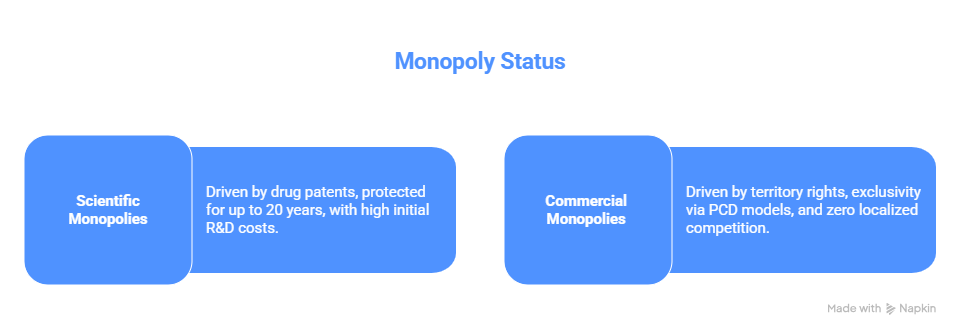
- The R&D/Patent Model: When a pharmaceutical innovator develops a new molecular entity (NME), they are granted a patent—typically for up to 20 years. During this period, no other manufacturer can legally produce or sell that exact chemical formulation, allowing the patent holder to set prices and recoup high research and development costs.
- The PCD Franchise Model: In the domestic B2B trade sector, a monopoly company refers to a manufacturer that grants exclusive territorial rights to a franchise partner or distributor. Under this agreement, the parent company guarantees that no other individual or firm will be supplied with the same brand names within that designated city or district, eliminating internal brand competition.
Top 5 Monopoly Pharma Companies in India
The Indian domestic market features several high-performing pharma manufacturing and marketing hubs that specialize in providing exclusive, monopoly-based distribution rights to domestic investors:
1. Amista Labs
Based out of the prominent pharmaceutical clusters of Panchkula and Mohali, Amista Labs is an ISO 9001:2015 and WHO–GMP certified industry leader. The company commands a massive portfolio of over 1,500+ premium formulations spanning critical care injectables, pediatric dry syrups, advanced antibiotics, dermatology, and multi-vitamin nutraceuticals. Amista Labs is widely recognized for its robust, district-wise monopoly franchise network, backing its partners with transparent net-rate pricing structures and high-end promotional kits to capture localized medical markets seamlessly.
Driven by cutting-edge research and strict quality control, the company ensures that every batch meets global safety standards, giving franchise partners immense clinical credibility among healthcare professionals. Furthermore, their highly efficient supply chain management and zero-deficit inventory tracking guarantee timely product delivery, enabling distributors to maintain uninterrupted market operations and maximize their local return on investment.
2. Progressive Life Care
Operating from Ahmedabad, Gujarat, Progressive Life Care has built an excellent reputation for ethical marketing and structured PCD franchise models. They focus extensively on providing clear, ironclad territory allocations across major therapeutic segments, including cardiac care, diabetic management, and specialized herbal formulations. Their franchise strategy ensures that local medical representatives (MRs) and distributors can build self-sustaining operations completely protected from cross-border brand dumping.
3. Ambit Bio Medix
Another major powerhouse based in Ahmedabad, Ambit Bio Medix boasts a diverse portfolio of over 400+ highly targeted pharmaceutical products. The company is structured specifically to empower small-scale healthcare entrepreneurs by delivering certified tablets, capsules, powders, and topical ointments with strict geographical exclusivity. Their in-house testing labs ensure a seamless, multi-tier quality assurance pipeline before products are dispatched to domestic distributors.
4. Tesni Pharmaceuticals
Tesni Pharmaceuticals is highly regarded for its structured, value-driven monopoly distribution frameworks. Specializing in high-volume, affordable healthcare formulations, Tesni offers broad therapeutic coverage including antioxidants, advanced anti-bacterial agents, and specialized pediatric drops. Their business model focuses on lowering the minimum order barriers, making them a premier choice for first-time pharma investors seeking exclusive territorial ownership.
5. Fossil Remedies
As a prominent player in the generic and ethical drug marketing divisions, Fossil Remedies offers exhaustive franchise opportunities across India. Their monopoly-based distribution architecture ensures that their franchise partners can successfully cultivate deep relationships with local hospital networks, private clinics, and retail chemists without facing localized friction from the same parent brand.
The Core Pillars: Manufacturers, Suppliers, and Distributors
To understand how monopoly medicine flows from raw active ingredients to the patient’s prescription pad, it is necessary to analyze the three interconnected pillars of the pharmaceutical supply chain:
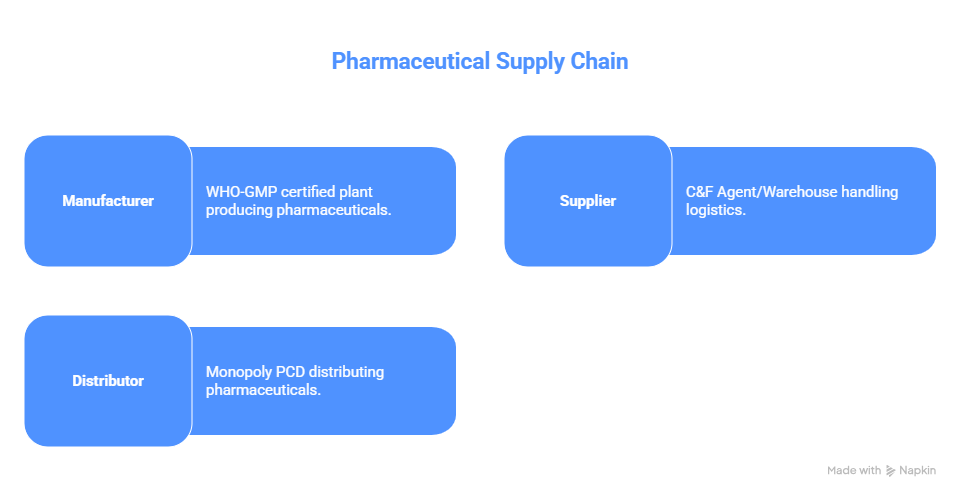
1. The Pharma Manufacturer (The Production Engine)
The manufacturer is responsible for the actual synthesis, formulation, and packaging of the pharmaceutical drug. Operating out of state-of-the-art facilities that must strictly comply with WHO-GMP (World Health Organization – Good Manufacturing Practices) and DCGI (Drug Controller General of India) guidelines, the manufacturer manages the heavy industrial overheads. They source Active Pharmaceutical Ingredients (APIs), perform stability testing across varying climatic parameters, and package medicines in secure Alu-Alu or blister packs.
2. The Pharma Supplier (The Logistics & Compliance Channel)
Once the batches are cleared by quality assurance (QA) departments, the supplier—often operating as a clearing and forwarding (C&F) agent or national corporate warehouse—steps in. Suppliers manage the large-scale bulk warehousing, cold-chain preservation systems for sensitive biologicals, and interstate regulatory documentations (such as e-way bills and GST invoicing). They act as the vital bridge ensuring that stock levels remain consistent and that regional supply lines do not face depletion or stockouts.
3. The Pharma Distributor (The Local Field Force)
The distributor is the direct touchpoint for the local healthcare ecosystem. Operating under a localized monopoly agreement, the distributor utilizes their regional network to supply retail pharmacies, institutional hospital counters, and nursing homes. By employing medical representatives to directly pitch product glossaries, clinical advantages, and sample batches to practicing physicians, the distributor converts regional health demands into high-margin commercial sales.
Impact of Monopolies on India’s Healthcare Ecosystem
Monopoly positioning in the pharmaceutical sector creates a complex economic dynamic that presents both distinct industry advantages and strict regulatory challenges.
The Strategic Advantages
- Incentivizing Clinical Innovation: Developing a new drug molecule requires years of clinical trials and immense capital investment. Legal monopolies via patent protections ensure that innovative firms can fully recover their R&D investments, funding future medical breakthroughs.
- Territorial Business Stability: In the franchise domain, regional monopoly rights protect small business owners from predatory pricing and over-saturation, allowing small medical distribution startups to thrive in Tier-2 and Tier-3 markets.
The Regulatory Challenges
- Accessibility and Pricing Concerns: Unchecked market dominance can lead to inflated drug pricing, rendering advanced medical treatments inaccessible to low-income populations.
- Price Standardization Systems: To protect public welfare, the Indian Government actively intervenes through the NPPA (National Pharmaceutical Pricing Authority) and the DPCO (Drugs Prices Control Order). These bodies implement hard price ceilings on essential medicines, ensuring that even when a company holds exclusive distribution rights, the end consumer is protected from price gouging.
Frequently Asked Questions
What is the primary difference between a generic pharma model and a monopoly PCD pharma model?
In a standard generic or open PCD model, a company may appoint multiple distributors within the same territory, leading to intense internal price undercutting. In a monopoly PCD model, you are granted absolute exclusivity—no other distributor can purchase or sell those specific brand names within your assigned geographic boundaries.
What legal certifications are required to partner with a monopoly pharma company?
You must possess a valid Wholesale Drug License (DL) issued by your respective State Drug Control Administration and a valid GST Registration number to legally process pharmaceutical transactions and clear regional logistical checkpoints.
How does the NPPA impact monopoly medicine companies in India?
The National Pharmaceutical Pricing Authority (NPPA) monitors and regulates the maximum retail prices (MRP) of essential medicines under the Drugs Prices Control Order (DPCO). Even if a company holds an exclusive patent or market monopoly, they cannot price a drug above the government-mandated ceiling if it falls under the essential medicines list.
Can a monopoly franchise partner sell outside their allotted district?
No. Monopoly agreements are strictly bound by geographic parameters. Selling products outside your designated territory violates the franchise agreement and can result in the immediate cancellation of your exclusive distribution rights.
What is the standard minimum order value (MOV) to secure a monopoly territory?
The initial investment varies depending on the company and the economic size of the district. Generally, top firms like Amista Labs offer accessible entry models starting anywhere between ₹20,000 to ₹50,000 for an initial product stock order.
How long does a standard pharmaceutical patent monopoly last in India?
Under the Indian Patents Act, a product patent for an innovative pharmaceutical drug formulation is typically granted for a maximum duration of 20 years from the initial date of filing, after which generic manufacturers can freely reproduce it.
What happens to a monopoly drug when its patent expires?
Once a patent expires, the formula enters the public domain. Other pharmaceutical manufacturers can legally introduce generic equivalents. Increased market competition typically drives down the drug’s retail price by 60% to 90%.
Do monopoly pharma companies provide promotional support to franchisees?
Yes. Top-tier companies supply complete ethical marketing toolkits, which include visual aids, product catchcovers, detailed glossaries, sample packs, prescription pads, reminder cards, and customized corporate gifts for doctors.
Is prior experience as a Medical Representative (MR) mandatory to get a monopoly franchise?
While a professional background as an MR or pharmaceutical wholesaler provides an immense advantage regarding local prescription patterns and physician networks, it is not legally mandatory. Anyone with a valid drug license and capital can invest.
How do I maintain product quality and compliance at the distributor level?
Distributors must maintain a clean, temperature-controlled, and pest-free commercial godown. Sensitive formulations like softgel capsules, liquid injectables, and vaccines must be kept in dedicated refrigeration units matching the exact storage parameters specified on the packaging to preserve chemical stability.
Conclusion
In summary, the Indian pharmaceutical sector continues to offer incredible avenues for sustainable business growth, with monopoly pharma models leading the charge. Companies like Amista Labs are redefining market dynamics by empowering independent entrepreneurs with extensive product portfolios, strict quality compliances, and absolute geographic exclusivity. By eliminating local brand rivalry and providing specialized promotional backing, this commercial framework simplifies market entry for investors and medical professionals alike. As healthcare demands escalate across India, aligning with a transparent, WHO-GMP certified partner is the single most effective step toward building a resilient, high-margin, and future-proof pharmaceutical enterprise.



 Users Today : 51
 Users Yesterday : 133
 Users This Month : 1057
 Users This Year : 13698
